 +1 (774)478-6704
 Order@premiumonebackdrops.com


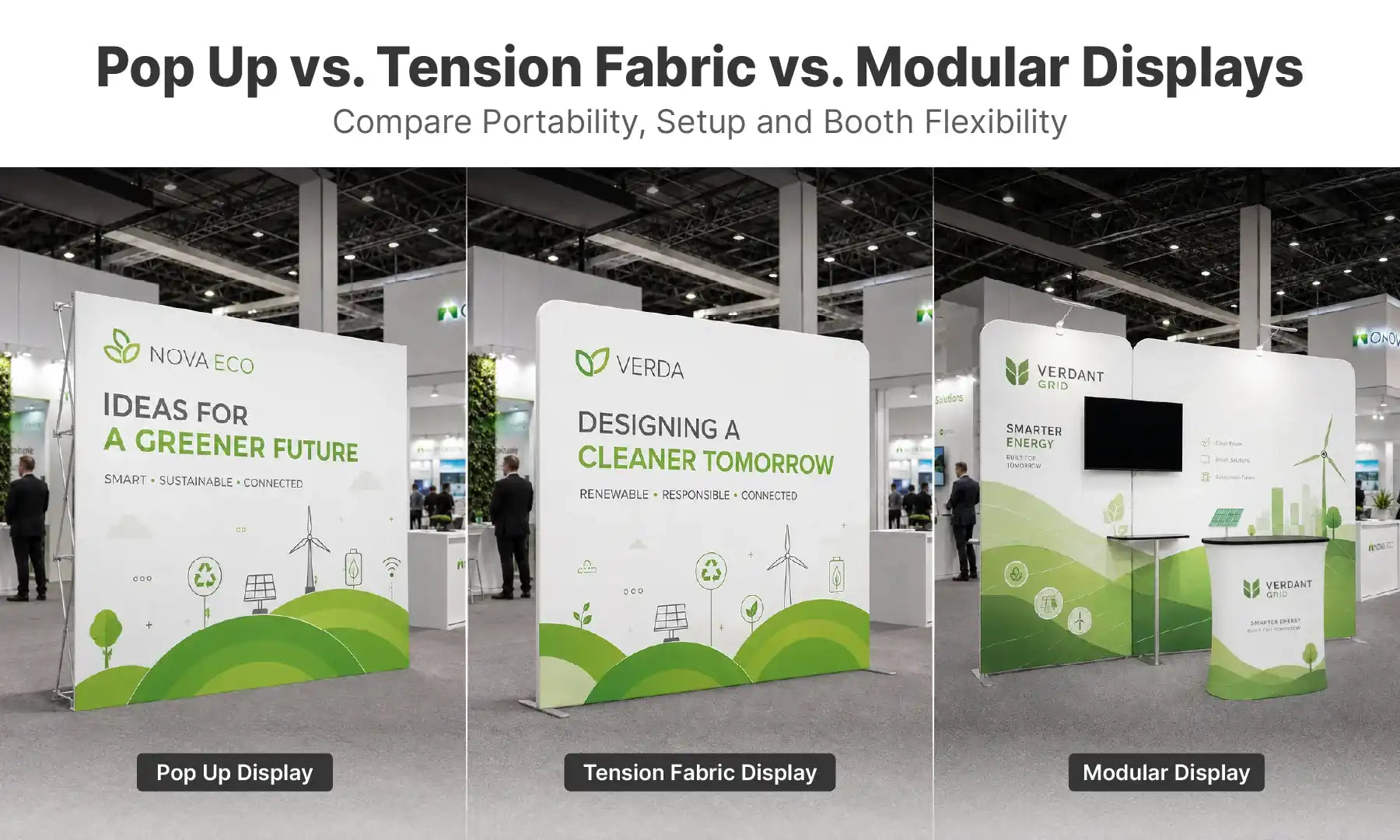
Pop up, tension fabric, and modular displays can all create a professional trade show booth, but they are built for different needs. A pop up display focuses on portability and simple setup. A tension fabric display offers a smooth graphic finish and more shape options. A modular display provides greater layout flexibility but requires more planning, components, and budget.
The right choice depends on your booth size, event schedule, setup team, transportation plan, and the activities that need to happen inside the space.
Before ordering, review the exhibitor manual for each show. Rules for booth height, electrical service, labor, material handling, and installation vary by event. Freeman’s guide for exhibitors in the United States provides a useful overview, but your own event documents remain the final reference.
First, Understand How the Three Display Systems Are Built
All three systems may use printed fabric graphics, but the structure underneath is different.
- Pop up display: A collapsible lattice-style frame expands into shape. The graphic attaches to or fits over the opened frame.
- Tension fabric display: Aluminum tubes or frame sections connect before a fitted stretch-fabric graphic is pulled over the structure.
-
Modular display: Reusable frames, panels, connectors, counters, shelves, light boxes, or other compatible components form a larger booth system.

Pop Up Displays: A Practical Balance of Portability and Value
A pop up display is a strong starting point for exhibitors who need a large branded wall without managing a complicated structure. The connected frame expands quickly and folds down for transport after the event.
Advantages of Pop Up Displays
- Simple assembly: The connected frame reduces the number of loose sections that must be joined.
- Compact transport: The frame collapses, while the graphic can be packed according to its care instructions.
- Controlled entry cost: One display can create a complete-looking booth background without a large modular build.
- Reusable hardware: Compatible replacement graphics may update the same frame for later campaigns.
- Useful format choices: Straight, curved, end-cap, SEG, and backlit models support different presentation goals.
Limitations of Pop Up Displays
A standard pop up wall is less flexible than a modular system. One frame cannot usually be rearranged into several completely different booth layouts. Accessories such as monitor mounts must be designed for the exact model and used within confirmed weight limits.
Best for: First-time exhibitors, small businesses, schools, nonprofits, traveling sales teams, and frequent exhibitors who prioritize portability, straightforward setup, and controlled costs.
Tension Fabric Displays: Smooth, Modern, and Versatile
A tension fabric display combines a lightweight aluminum frame with a fitted stretch-fabric graphic. Once installed, the fabric creates a smooth surface with minimal visible hardware.
These systems are available in straight and curved walls as well as S-shaped, U-shaped, and other dimensional forms. They suit brands that want a polished visual background while keeping the structure portable.
Advantages of Tension Fabric Displays
- Smooth graphic finish: Fitted fabric creates clean edges and a modern presentation.
- More shape choices: Tube frames can form straight walls, curves, waves, and dimensional structures.
- Portable components: Frame sections and fabric can pack into manageable bags or cases.
- Reusable frame: The structure can support later events when the replacement graphic is fully compatible.
- Distinctive visual style: Shaped frames add movement without requiring a complete modular booth.
Limitations of Tension Fabric Displays
The frame contains more separate sections than a collapsible pop up display, so assembly involves additional connections. A larger fabric graphic may also be easier to install with two people because it must be centered and pulled evenly over the structure.
The fit is model-specific. A replacement graphic must match the exact frame size, shape, seams, and closure method.
Best for: Brands that want a smooth photo or presentation wall, creative shapes, and a polished finish while keeping the display reusable and transportable.
Modular Displays: More Flexibility for a Complete Booth
A modular display uses several compatible components rather than one main backdrop. Depending on the system, a booth may include SEG walls, towers, bridge sections, counters, shelves, storage, monitor supports, light boxes, and multiple graphic panels.
Advantages of Modular Displays
- Flexible layouts: Compatible components may be rearranged or expanded for different booth sizes.
- Stronger booth presence: Several walls and functional elements create a more complete environment.
- Separate activity zones: The layout can support demonstrations, product displays, meetings, lead collection, and storage.
- Long-term planning: A well-designed system can support several shows with updated graphics and configurations.
- Integrated features: Suitable systems may support approved counters, shelving, monitors, and illuminated graphics.
Limitations of Modular Displays
Modular systems normally have a higher initial cost and more parts to manage. The budget should include the display, graphics, cases, freight, material handling, electrical service, storage, setup time, and any required labor.
Installation also needs more organization. Components should be labeled, packed in order, and tested before shipment. Larger builds may require several installers or approved show labor, depending on the event rules.
Best for: Established exhibitors, larger booth spaces, multi-zone layouts, product demonstrations, and brands running a long-term exhibition program.
Pop Up vs. Tension Fabric vs. Modular Displays: Quick Comparison
| Comparison Point | Pop Up Display | Tension Fabric Display | Modular Display |
|---|---|---|---|
| Structure | Collapsible connected frame | Connected tube or sectioned frame | Multiple compatible components |
| Setup | Usually the simplest | More frame connections | Varies by component count |
| Transportation | Compact collapsible frame | Portable with separate sections | More cases and freight planning |
| Budget | Lower to mid-range | Lower to mid-range, depending on shape | Mid to higher range |
| Visual style | Clean and compact | Smooth and shaped | Layered and architectural |
| Layout flexibility | Limited | Moderate through frame choices | Highest with compatible parts |
This table is a general guide. Compare the exact product size, included components, packed dimensions, installation instructions, power needs, and venue requirements before ordering.
Which Display Is Right for Your Event?
Choose a Pop Up Display for Speed and Simplicity
Start with a pop up display when a small team needs to manage setup, the display travels often, storage space is limited, or the budget must remain controlled. It provides a professional branded wall without introducing many separate components.
Choose Tension Fabric When Shape and Finish Matter
Choose tension fabric when the smooth fitted graphic or the frame shape is an important part of the visual plan. It is a useful middle option between a collapsible back wall and a multi-component booth.
Choose Modular When the Booth Must Support More Activities
Choose a modular system when you need separate zones, product displays, integrated features, or different configurations across several shows. The investment makes more sense when those functions support a long-term event strategy.
A Five-Step Checklist Before You Buy
- Confirm booth dimensions. Record the spaces booked for upcoming events and check the finished display footprint.
- Count the setup team. Decide who will install, dismantle, repack, store, and transport the system.
- Calculate the complete cost. Include graphics, cases, freight, handling, storage, electrical service, and possible labor.
- Define the visitor activity. Decide whether the booth supports conversations, demonstrations, meetings, photography, or several functions.
- Plan for future events. Confirm whether the hardware, graphics, and compatible components can support expected changes.
Freeman’s first-time exhibitor checklist also recommends planning inbound and outbound shipping, setup and teardown, and shipment records before the show.
Frequently Asked Questions
Can these trade show displays be used outdoors?
Use a display outdoors only when the exact product is designed for exterior use and the manufacturer confirms its base, anchoring, and weather limits. Wind, uneven ground, and rain can affect stability and graphic life, so do not use an indoor display outside without approval.
What artwork files should I prepare before ordering?
Use the artwork template for the exact product and size. A vector logo is preferred when available, and placed images should be clear at final print size. Keep important text inside the safe area, confirm colors and spelling, and export the final file according to the instructions on the selected product page.
How early should I order before my event?
Work backward from the required delivery date and allow time for artwork preparation, proof review, production, and shipping. The schedule depends on the product, quantity, artwork readiness, destination, and event date. Begin file review early instead of waiting until the final shipping window.
Can one display system work with different booth sizes?
A fixed pop up or tension fabric frame keeps the same finished dimensions, but it may be repositioned or paired with compatible displays in a larger space. A modular system offers more flexibility only when its components are designed to connect in multiple approved configurations. Confirm every planned layout before ordering.
Make the Display Match Your Trade Show Goals
Choose the system your team can transport, install, use, and reuse confidently. Pop up displays offer portability and value. Tension fabric displays add smooth graphics and creative shapes. Modular displays provide the most flexibility for larger, more detailed booth environments.
Explore the Pop Up Display collection, compare Tension Fabric Displays, or browse the complete Trade Show Display collection. For help choosing a system, contact POB with your booth size, event date, setup team, and required functions.