 +1 (774)478-6704
 Order@premiumonebackdrops.com


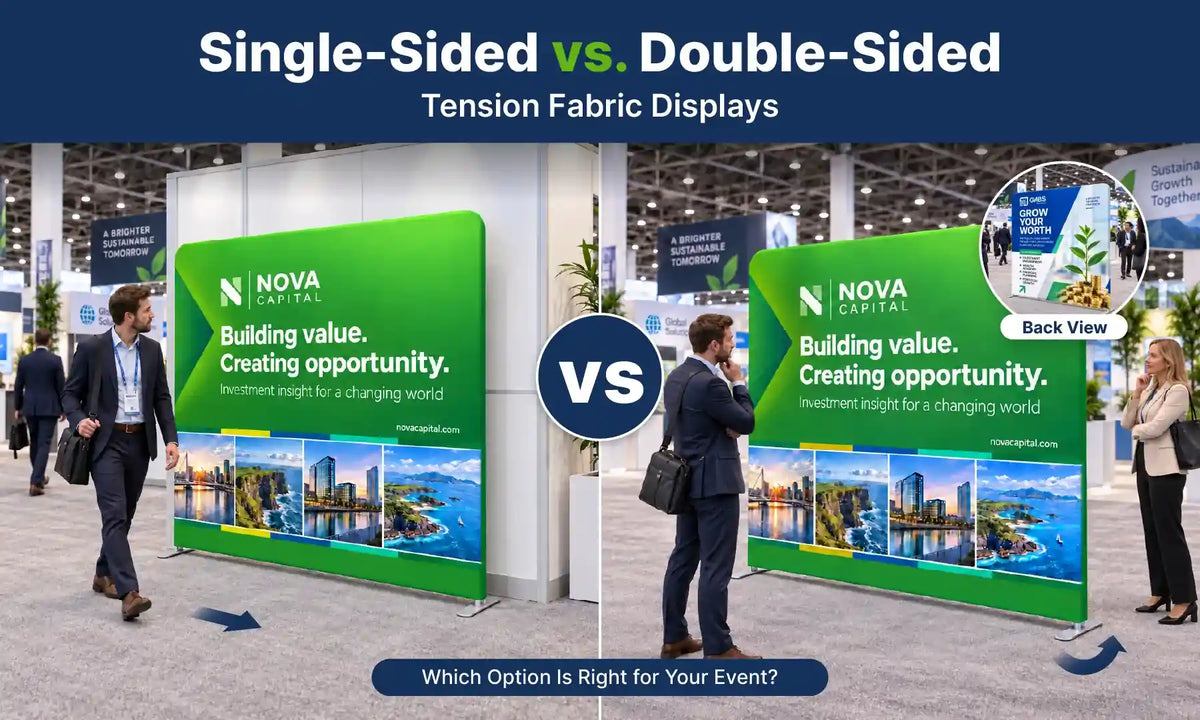
Once you choose the size and shape of a tension fabric display, one practical decision remains: should the graphic be single-sided or double-sided? The answer affects cost, artwork, placement, and visibility.
Double-sided printing is not automatically better. A single-sided display may be all you need when the back faces a wall, while a second printed face becomes useful when people approach from more than one direction. POB’s Tension Fabric Wall Displays include different shapes and print options for these situations.
The best choice starts with the floor plan. Consider where the display will stand, which sides remain visible, and whether the reverse has a useful purpose. This guide compares both options by placement, artwork, budget, and future use.
In This Guide
- Single- vs. double-sided display differences
- The best option for different booth layouts
- How frame shape affects visibility
- One-design vs. two-design artwork planning
- Cost, ordering, indoor/outdoor use, and a final checklist
Single-Sided Tension Fabric Displays: Best Uses and Limitations
A single-sided tension fabric display carries artwork on the main viewing face. On relevant POB products, the reverse is clean white.
Single-sided printing is practical when only one face is visible, such as against an inline-booth wall, behind a registration desk, along a retail wall, or behind a speaker. Printing the hidden reverse may add little value.
A front-facing Straight Tension Fabric Backdrop Display works well for predictable one-direction viewing without paying for hidden artwork.
Double-Sided Tension Fabric Displays: When Two Printed Faces Help
A double-sided tension fabric display carries graphics on both faces. The sides can repeat the branding or present different messages in two directions.
Double-sided printing is useful in open spaces, between two aisles, as a zone divider, or where visitors can walk behind the structure.
Freeman’s guide to boosting booth presence recommends considering booth configuration, floor location, and expected traffic. Those factors should guide the number of printed faces you order.
Single-Sided vs. Double-Sided Tension Fabric Displays at a Glance
| Factor | Single-Sided Display | Double-Sided Display |
|---|---|---|
| Printed surfaces | One printed face with a white reverse | Printed graphics on both faces |
| Best placement | Against a wall or at the back of a booth | Open areas, central positions, or two-way traffic |
| Visibility | One main viewing direction | Opposite viewing directions |
| Artwork planning | One layout to prepare and approve | Two faces to prepare, orient, and review |
| Budget | Usually the more economical option | Usually costs more because both faces are printed |
| Best for | Inline booths, stages, and wall displays | Open booths, dividers, and multi-angle branding |
How Booth Placement Affects Single- or Double-Sided Printing
Your booth layout is often more important than the display shape. Mark the intended position on the floor plan and draw arrows showing how visitors will approach it.
Inline Booth or Wall Placement
If the display sits at the back of a standard inline booth, the reverse is normally hidden. Single-sided printing is generally enough for a branded back wall, presentation stage, press wall, or reception area.
Corner Booth Placement
A corner booth is open on two adjoining sides, but it does not automatically require a double-sided graphic. If the display stays against the closed back boundary, only the front may be visible. If it is angled toward an aisle, visitors may see the reverse. Check the actual position instead of deciding from the booth type alone.
Peninsula, Island, or Open Event Area
In an open layout, people may approach from several directions. A double-sided display can communicate on both faces or divide two zones, with a welcome message facing the aisle and supporting information facing inward.
The IAEE education catalog treats booth type and attendee traffic as important planning considerations. Decide where people will walk before choosing the printed sides.
How Display Shape Changes Viewing Angles
Shape should be evaluated together with placement. A straight display has a clear front and back. A Curved Tension Fabric Backdrop Display reveals more of its side profile, although single-sided printing can still work for one-direction viewing.
An S Shape Tension Fabric Backdrop Display presents changing surfaces as visitors move around it. A U Shape Tension Fabric Backdrop Display can define a semi-enclosed area. For either shape, identify which curves face the aisle and whether guests can walk behind the frame. A shaped display placed against a wall may still need only one printed face.
Planning Double-Sided Tension Fabric Display Artwork
A double-sided display does not require two completely different designs. Repeating the same artwork on both faces creates consistent branding and simplifies approval. This works well for sponsor walls, recruiting events, recurring campaigns, and structures positioned between two aisles.
Different artwork is useful when the faces have separate jobs. The aisle-facing side might introduce the brand, while the inward-facing side explains products. One face can be a photo backdrop while the reverse provides event information, a QR code, or a call to action.
When the artwork differs, label the files Side A and Side B. Confirm which side faces each direction and review both proofs together. Keep important text away from seams, zippers, edges, and strong curves.
Comparing Cost With Useful Visibility
Double-sided printing generally costs more because it adds another printed surface. That cost can be worthwhile when the reverse receives meaningful traffic, but unnecessary when it always faces a wall.
Before ordering, ask whether people will see the back, whether it has a clear communication purpose, and whether the display will be reused in open layouts. If all three answers are no, single-sided printing is probably the better value. If the reverse repeatedly faces an aisle, entrance, meeting area, or camera, double-sided printing may provide useful exposure.
Reusable frames and replacement graphics can support future campaigns, but a new cover is not universally compatible with every frame. Confirm the exact product, size, shape, and graphic construction before ordering a replacement.
Artwork Checks Before Ordering a Tension Fabric Display
Match the design to the viewing distance. Keep the logo and headline readable, avoid essential details near edges, and follow the product template.
Before approving production, confirm:
- Final display size and orientation
- Single-sided or double-sided print selection
- Correct Side A and Side B file orientation
- Logo, spelling, dates, URLs, and QR codes
- Image resolution and required color mode
- Safe areas, seams, curves, and zipper position
- Whether you are ordering a complete display or graphic only
Standard tension fabric walls are not backlit light boxes, so prepare the artwork for the venue’s available lighting rather than expecting internal illumination.
Indoor and Outdoor Use of Tension Fabric Displays
Most portable tension fabric walls are primarily designed for indoor environments. Double-sided printing does not make a display suitable for outdoor use. Wind, weather, ground conditions, base design, and anchoring all affect safety.
For an outdoor event, confirm that the specific product is approved for the location and follow the venue’s instructions. A purpose-built outdoor display may be more appropriate when wind or changing weather is expected.
Which Tension Fabric Printing Option Should You Choose?
Choose single-sided printing when the display stays against a wall, guests face it from one direction, and the reverse would rarely appear in photos or videos. It is usually the simpler and more economical choice for back walls, stages, and focused photo areas.
Choose double-sided printing when the structure stands in an open or central location, people approach from opposite directions, or each face has a defined communication purpose. The second printed side should solve a visibility or messaging need rather than simply add another graphic.
Start with the floor plan and assign every printed face a clear job. If you need help matching the print option to your layout, share your event date, delivery location, booth plan, and artwork requirements through the POB contact page.
Frequently Asked Questions About Single- and Double-Sided Displays
Can a double-sided tension fabric display use different artwork on each side?
Generally, yes, when the selected product offers double-sided printing. Label the files Side A and Side B and confirm their orientation before approval.
Is a single-sided display enough for a corner booth?
It can be. If the reverse stays against the closed boundary, single-sided printing may work. Check whether visitors can see behind the display.
Can I change from a single-sided graphic to a double-sided graphic later?
Compatibility depends on the exact frame, size, shape, and cover construction. Confirm the existing product details before ordering a replacement graphic.
Is double-sided printing necessary for a curved display?
Not always. Placement and visitor movement matter more than shape alone. Double-sided printing helps when traffic can see both sides of the curve.
Which option is better for a photo backdrop?
Choose single-sided for one fixed camera direction. Choose double-sided when the backdrop will be repositioned or photographed from angles that reveal the reverse.