 +1 (774)478-6704
 Order@premiumonebackdrops.com


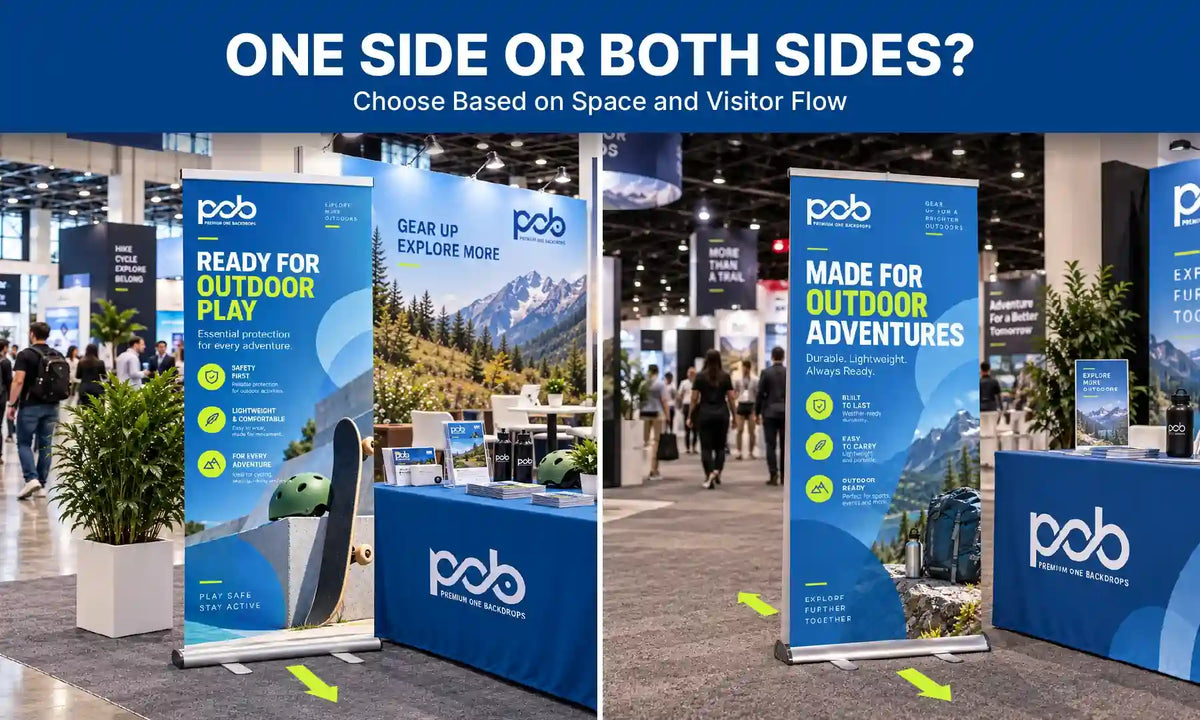
Choosing between a single-sided and double-sided banner stand comes down to where people will see it. If the banner faces one main direction, a single-sided display may be enough. If visitors approach from both sides, a double-sided banner can make better use of the space. Your booth layout, artwork, and hardware configuration all matter when making the choice.
Single-Sided vs. Double-Sided Banner Stands at a Glance
| Feature | Single-Sided Banner | Double-Sided Banner |
|---|---|---|
| Viewing Direction | One main direction | Two directions |
| Typical Placement | Against walls or behind counters | Open spaces and two-way traffic areas |
| Artwork | One main design | Same or different designs on each side |
| Hardware | Designed for one display face | Designed to support both display faces |
| Best Use | Focused, front-facing messaging | Branding for visitors approaching from different directions |

Browse our Banner Stand Collection to compare display styles for different event spaces.
Which Banner Stand Fits Your Event Layout?
Start by looking at where the banner will stand and how visitors move around it. The same display can work differently depending on whether it sits against a wall, near a counter, or between two busy aisles.
| Event Layout | Recommended Option | Why It Works |
|---|---|---|
| Inline booth | Usually single-sided | Most visitors approach from the front aisle, so the reverse side may remain hidden. |
| Corner booth | Single- or double-sided | Use single-sided when the banner faces one aisle; consider double-sided when both faces are visible from separate approaches. |
| Open exhibition space | Often double-sided | Visitors may approach from either direction, making both graphic faces useful. |
| Reception area or wall placement | Usually single-sided | A second graphic offers little value when the back faces a wall or remains out of view. |
For a front-facing promotional message, a Roll Up Banner is a practical option. If you need visibility from both directions, consider a purpose-built Double-Sided Teardrop Roll Up Banner.
For larger exhibits, the banner should also work with the main backdrop, counter, and visitor path. Our 10ft Trade Show Booth Displays provide examples of how portable displays can fit into a coordinated booth layout.
Plan Artwork for One or Two Viewing Directions
A single-sided banner has one clear job: communicate its main message to visitors approaching from the front. Keep the logo, headline, key visual, and call to action easy to follow, and position important information where people, tables, or counters are less likely to block it.
With a double-sided banner, decide whether both faces should repeat the same design or serve different purposes. Matching graphics reinforce brand recognition, while separate designs can introduce a product on one side and provide directions or a QR code on the other. If the banner is part of a larger fabric display, a Portable Tension Fabric Banner Stand offers another format for presenting branded graphics.
For more ideas on arranging logos, headlines, visuals, and calls to action, read our Roll Up Banner Design Guide: What Should You Put on a Retractable Banner?. The same basic principles of clear messaging can help you plan either format.
Check Hardware Compatibility Before Ordering
Double-sided printing is not simply a matter of adding another graphic to an existing stand. The hardware must be designed for the intended configuration, and the frame, graphic dimensions, and attachment method must all match. For example, a standard retractable banner should not automatically be assumed to support a second graphic on the reverse side.
If you prefer a different mounting structure, an EZ Banner Stand uses a different graphic mounting system from a retractable roll-up banner. Check the product specifications before ordering, especially if you plan to reuse existing hardware.
When submitting different designs for each side, label the files clearly as FRONT and BACK. Confirm the selected product configuration and approve both designs before production begins.

Plan for Future Use
If you use the same banner at different events, consider whether its placement is likely to change. A display that always sits against a wall may only need one printed side, while a stand that moves between reception areas, conferences, and open exhibition spaces may benefit from two-sided visibility. Keep the product name, size, and artwork template with your event files so replacement graphics can be matched to the original hardware.
Frequently Asked Questions
Does double-sided printing make a banner stand take up more floor space?
Not necessarily. The footprint depends on the specific stand design. Check the assembled dimensions and product specifications rather than assuming that a double-sided model will occupy more or less space.
Will a double-sided banner make the message easier to read?
It gives visitors another direction from which to see the message, but it does not automatically improve readability. Keep each design clear and concise, and make sure the text and graphics are suitable for the expected viewing distance.
Do I Need to Submit Two Artwork Files for a Double-Sided Banner?
If you want different designs on each side, prepare two separate files and label them clearly as FRONT and BACK. If both sides use the same design, confirm the artwork requirements with your supplier before submitting your files.
Choose a Banner Stand for Your Display Location
Before ordering, consider the viewing direction, booth layout, artwork, and hardware configuration. If you need help confirming the right option, contact the POB team with your event layout, banner size, and artwork requirements.