 +1 (774)478-6704
 Order@premiumonebackdrops.com


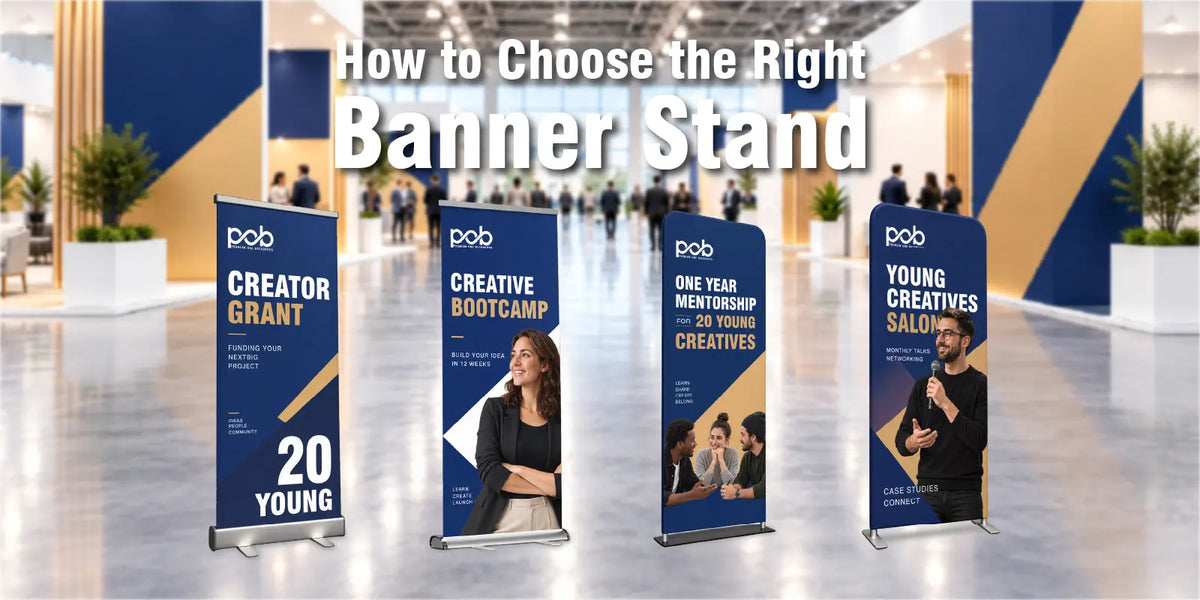
Product names alone rarely tell you which banner stand will work best. A display that looks right in a photo may not suit your floor space, viewing direction, travel routine, artwork, or future campaigns.
This banner stand buying guide puts those decisions in a practical order. Start with where the stand will go and how people will see it, then compare structure, size, graphics, and ordering options.
Quick answer: Choose a single-sided retractable banner for a front-facing message and simple setup. Choose a double-sided stand when people approach from two directions. Choose a tension fabric stand for a smooth fabric finish and framed presentation. Always confirm the size, configuration, and graphic compatibility before ordering.
In This Guide
- How display location affects your banner stand choice
- When to choose a single-sided or double-sided banner stand
- How retractable and tension fabric structures compare
- What size, artwork, and ordering configuration to select
- What to check before placing your order
Start with the Display Location
A banner stand that suits a trade show may not suit a retail entrance or conference reception.
- Trade show booth: Introduce a product, support the backdrop, show a QR code, or guide visitors.
- Booth entrance: Stay visible without narrowing the entrance or interrupting visitor flow.
- Retail space: Highlight a promotion, new product, service, or direction.
- Conference: Identify a registration desk, session room, or sponsor.
- Pop-up event: Balance graphic size with portability and compact storage.
Measure usable floor area, including the base or feet, nearby furniture, and visitor flow. The Freeman booth design guide explains that in-line, peninsula, and island booths have different open sides and sightlines. Your event manual remains the final source for show rules.
Retail displays should also stay outside required accessible routes. The ADA primer for small businesses says accessible paths must remain clear and not be blocked by display racks or similar items. Check the rules for your location before placing a freestanding sign.
Decide Who Needs to See the Graphic
Stand where visitors will stand and look at the location from each normal approach. This usually reveals whether you need one printed side or two.
Choose Single-Sided When the Back Is Not Part of the Experience
A single-sided banner is usually enough near a wall, inside an in-line booth, behind a desk, or wherever traffic comes from one main direction. A second print may add little value when the back remains hidden.
The Teardrop Roll Up Banner provides a front-facing retractable graphic with a curved profile. The Budget Roll Up Banner offers a straightforward format for promotions, presentations, and event signage.
Choose Double-Sided When Traffic Comes from Both Directions
A two-sided display makes more sense in an open area, at a booth corner, or near an entrance with traffic in both directions. The graphics can repeat one message or serve different purposes.
The Double Sided Teardrop Roll Up Banner keeps two graphics in one retractable base. Not every stand can become double-sided later; the exact hardware and graphic option must support it.
Compare Retractable and Tension Fabric Structures
The main structural choice is retractable or tension fabric. Neither is automatically better.
A retractable banner stores its graphic inside a cassette-style base. The print pulls upward and connects to a support pole, making this format useful when compact storage and a narrow floor-standing sign are priorities.
A tension fabric banner uses an aluminum tube frame covered by a stretch fabric graphic. It takes more assembly than a pull-up stand but creates a smooth fabric surface and different width options.
| Decision Point | Retractable Banner Stand | Tension Fabric Banner Stand |
|---|---|---|
| Basic structure | Graphic retracts into a base and is supported by a pole | Stretch fabric graphic fits over an assembled tube frame |
| Best for | Promotions, reception areas, retail messages, and wayfinding | Fabric branding, repeat events, and a framed visual surface |
| Graphic storage | Graphic normally stays protected inside the base between uses | Graphic is removed and packed according to its care instructions |
| Visual finish | Traditional pull-up presentation with a visible base | Smooth fabric presentation with minimal visible frame |
| Double-sided use | Requires a purpose-built double-sided model | Available only when the selected model supports it |
| Future graphic changes | Possible when the base and print specifications match | A compatible fabric print can often reuse the frame |
Match the Stand to Your Travel and Reuse Plan
Ask who will carry the stand, how it will travel, where it will be stored, and how often it will be assembled. Retractable graphics roll into their bases, while tension fabric systems separate into frame sections and fabric.
A carrying bag does not automatically meet airline or carrier limits. Confirm packed dimensions and weight before traveling, and choose hardware your team can assemble, repack, and store correctly.
Choose a Size for the Message, Not Just the Empty Space
The right size depends on viewing distance, available width, nearby displays, and content. A narrow roll up can hold one headline, a logo, a supporting image, and a clear call to action. More height will not fix a crowded layout.
For a compact message, consider a roll up. For a smooth fabric look, review the EZ Banner Stand or the taller Portable Tension Fabric Banner Stand. Check the selected dimensions before artwork begins.
Plan the Artwork Around the Viewing Moment
A useful event banner communicates one main idea quickly:
- Brand or main offer: Make it visible at the expected distance.
- Supporting message: Explain the product, service, or promotion in one short line.
- Action: Use one website, QR code, booth number, or instruction.
Keep important text away from trim areas, seams, the bottom cassette, and curved edges. Always use the correct product template.
Check Whether You Will Replace the Graphic Later
If campaigns change regularly, plan for replacement graphics from the beginning. They are not universally interchangeable: products with the same general width can use different dimensions, poles, bases, seams, zippers, or fabric tension.
Confirm the original product, supplier, order number, finished size, print side, material, and attachment method. If hardware is damaged, incomplete, or unidentifiable, a complete display may be more reliable.
Choose the Correct Ordering Configuration
Read every option before checkout. Listings may offer:
- Complete Display: Hardware, compatible print, and listed packing components.
- Graphic Only: A replacement print for confirmed compatible hardware.
- Hardware Only: A frame or base without a custom print, when offered.
- Single- or Double-Sided: The printed sides supported by that model.
For a first unit, Complete Display is usually the clearest starting point. Select Graphic Only only after confirming compatibility. The option, contents, and template must refer to the same model and size.
Which POB Banner Stand Fits Your Use?
- Budget Roll Up Banner: Front-facing promotions and retail messages.
- Teardrop Roll Up Banner: Single-sided retractable display with a curved profile.
- Double Sided Teardrop Roll Up Banner: Open areas with two-way traffic.
- EZ Banner Stand: Smooth stretch fabric with single- or double-sided options.
- Portable Tension Fabric Banner Stand: Taller fabric display for repeat events.
Compare the range in the Banner Stands collection. Choose according to placement, traffic direction, transport, message, and future graphics.
Banner Stand Buying Checklist
- Where will the stand be placed?
- From which direction will visitors approach?
- Does the back of the display remain visible?
- Do you prefer a retractable base or tension fabric frame?
- What is the usable floor space, including base or feet?
- How will it be transported and stored?
- Will you reuse the hardware or replace the graphic?
- Are you ordering Complete Display, Graphic Only, or Hardware Only?
- Does the artwork use the correct template?
- Have you checked the event manual and venue requirements?
- Does the deadline allow for proof, production, and delivery?

Frequently Asked Questions
What is the best banner stand for a trade show?
There is no single best model. Choose according to placement, viewing direction, preferred finish, artwork, and reuse.
Should I choose a single-sided or double-sided banner stand?
Choose single-sided when the back will not be seen. Choose double-sided when people approach from both directions. Confirm that the exact product supports two printed sides.
What is the difference between a roll up and a tension fabric banner stand?
A roll up retracts into a base and uses a support pole. A tension fabric banner uses a tube frame covered by stretch fabric. This affects setup, packing, finish, and graphic compatibility.
Can I order a new graphic for my existing banner stand?
Possibly, but compatibility must be confirmed. Provide the original product, supplier, order details, finished size, material, and attachment method. A general width such as “3ft” is not enough.
Can these banner stands be used outdoors?
Do not use an indoor banner stand outside unless the exact product is designed for it. Wind, uneven ground, and rain can affect safety. Check specifications, weather, placement rules, and anchoring requirements.
Final Recommendation
Start with the space, viewing direction, and preferred structure. Then confirm the size, configuration, package contents, template, and future graphic plan. For several locations or events, request a quote with the date, quantity, artwork status, and delivery details.